Monday, August 19, 2019

Peak Lenin - 7134 meters (23,405 ft)


Lenin Massif  
I wanted to write a blog about my recent experiences on Mt. Lenin but I wasn't sure who I would write it for.  For other mountaineers who need some guidance?  For friends who are interested in my adventures?  Or a broad application that transfers inspiration from one category to others?  "We all have Lenins in our lives…"  In the end I decided on a lose-lose-lose compromise between the three that is sure to be an unhelpful and un-inspirational. 

Mountaineers come in all shapes and sizes but their motivations are even more wide-ranging than their parka sizes.  However, one thing they all seem to share in common is a propensity to spend an inordinate amount of time thinking about why they are climbing the mountain they are on.  There are enormous books with entire life stories dedicated to solving this philosophical puzzle, but the best explanation I have heard came from a wise old Russian man sitting on the bench across from me in Camp 1 (he was at least 50).  His nose was burnt to a crisp and he had been walking like a constipated duck and that could only mean one thing - he had summitted the mountain and returned down.  So everyone crowded around and he told us, "A mountain peak is like a small seed that gets planted in your brain and grows until, as hard as you try, you can't NOT climb it."  And that describes my relationship with Lenin perfectly.  Three years ago somebody told me about a 7000 meter peak in the country of Kyrgyzstan that didn't require any permit or royalty fee or LO or even a visa and I just couldn't NOT climb it. 

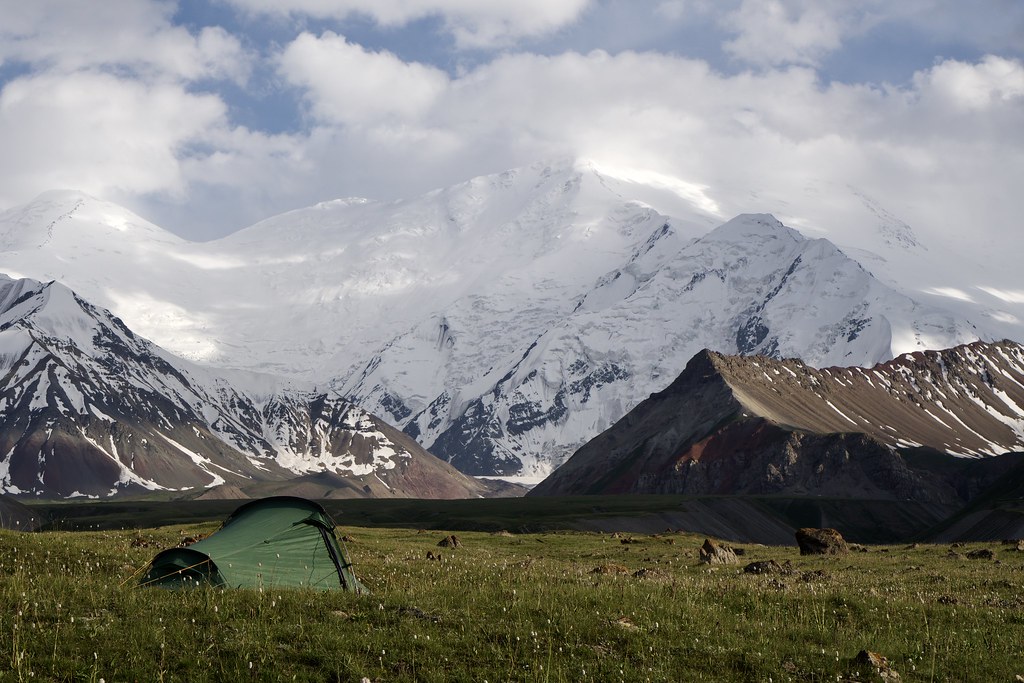
Basecamp, Peak Lenin
Basecamp - 3600 meters (11,800 ft)
Camp I
Camp I - 4400 meters (14,400 ft)
Camp II
Camp II - 5300 meters (17,400 ft)

Camp
Camp III - 6100 meters (20,000 ft)
I actually never intended to climb Lenin solo.  From three months before the trip, clear up until I was in Camp 1 (4400 meters - 14,450 ft) I was looking for people to team up with.  "Surely somebody else has no friends?"  Apparently not.  After I finally gave up I did find a rope of Poles (the ethnicity, not the object) who were gracious enough to let me clip on to their rope for the dangerous climb from Camp 1 to Camp 2.  I most likely would be typing this from the bottom of a crevasse right now if I hadn't met them, so I was more than happy to alter my schedule a little to join.

I also never intended to climb it in just nine days, but I kept getting bored sitting in my tent alone eating ramen and so at each camp I thought, "eh, I feel acclimatized enough, I'll just leave a day early."  And that's how I ended up sitting on top of Peak Lenin at 7134 meters (23,405 ft) five days ahead of schedule.  I had a lot of leftover ramen.

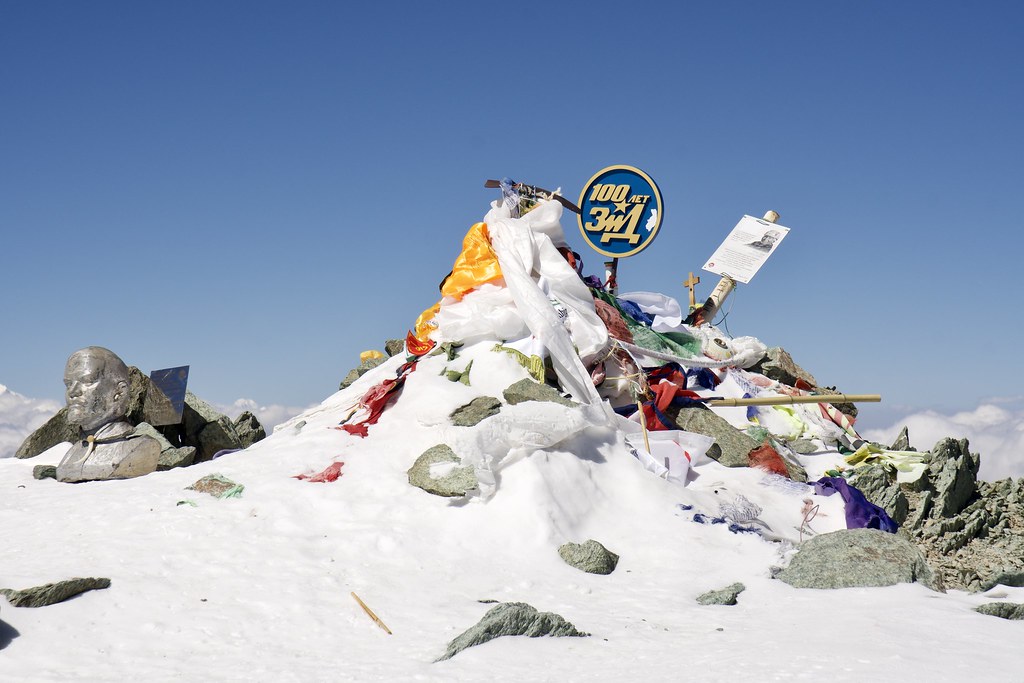
Lenin Summit 7134 Meters
The Peak!  (there was nobody to take my photo so I just took Lenin's)
   
My advice for Lenin:
  • Don't listen to any of the advice from backpackers or cyclists in Kyrgyzstan
  • Don’t hire a guide
  • Don't hire any horses or porters
  • Don't go through an agency
  • Don't plan anything before you arrive
  • Don't pitch your tent too close to the melted snow wall in Camp 2 (it's the "bathroom")
  • Buy 40 30 packs of ramen in Osh beforehand 

Also, don't listen to the "Tourist Info" guys in Osh.  Despite what they say you can indeed get a marshrutka to Sary Moghul and it will only cost $5 - saving you a $200 taxi ride.  In fact, as long as you already own all your own gear, and are willing to lug it up on your back, the cost of this mountain is negligible.  For those of you that don't climb Himalayan peaks as often, the normal bare-bones cost of climbing this high of a peak in any other country is at least $5000, and that's without a guide or gear. 

On a more serious note (just in case somebody actually does get inspired by my budget estimate) I will add a disclaimer.  Lenin is actually a quite dangerous peak.  It witnessed the largest mountaineering disaster ever recorded on a mountain when 43 climbers died in an avalanche in 1990 and still many people die each year due to altitude sickness, crevasses, exposure, etc.  While I was on the mountain 12 people either died or were seriously injured (like two broken legs and a broken arm).  On summit day, just 500 meters from the top, I came across a man who had gone blind (this happens when your goggles don't have enough UV protection) and had to rescue him off the peak.  So yeah, I recommend working your way slowly up to a 7000 meter peak.  If all your mountaineering experience is from the state of Michigan this probably isn't a good idea. 

View of Tajikistan
The view of Tajikistan from 22,000 ft
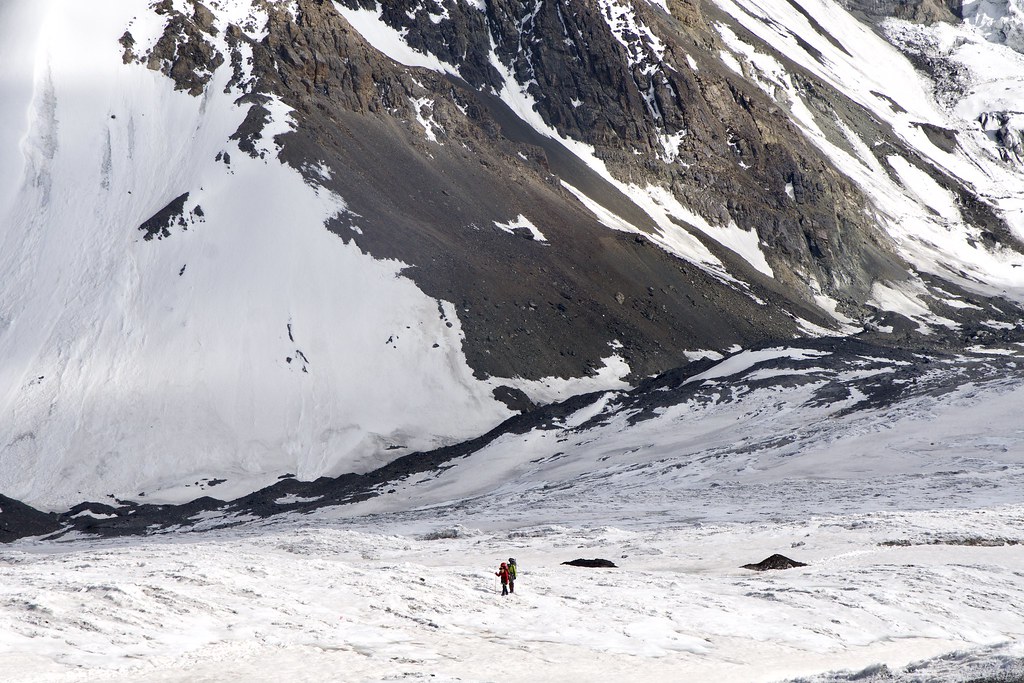
Glacier Travel
Headed down the glacier
Trekking
The way back to Base Camp
Some people consider Lenin to be the easiest of the world's 7000 meter peaks (there aren't too many to choose from since every one of them is located in Asia).  Well I think those people must have been on snowmobiles.  I had to spend nearly a week in Osh sitting and eating cheeseburgers just to recover.  Plus the tips of my fingers are still numb from summit day, now over two weeks ago.  Still, I can't complain too much, at least I was finally able to cut down my mountain-seed brain-tree. 

Bonus recommended gear list:
  • 4 season tent (or if necessary a $90 Walmart tent and a shovel to build snow walls around it)
  • 0 degF sleeping bag (but you'll have to combine it with every layer you brought and maybe light your cookstove at night in your tent)
  • Crampons
  • Plastic mountaineering boots (seriously, don't skimp, I saw two guys with legs frozen from the knees down)
  • Ice axe (despite their popularity ski poles will not help you self-arrest)
  • Harness and rope - 7mm, 20m is fine
  • Ice screws, descender, and jumar (there are maybe 5 to 10 fixed ropes but I actually didn't use any of them)
  • Gators
  • Two 500g fuel canisters and a JetBoil (or more snow walls around your stove)
  • USD - because in basecamp there are some folks who will sell you a hot dinner for $10
  • Serious sun protection (or just get roasted)
  • Really really warm gloves and stuff (think -20 degrees with a 70 mph wind)
  • Dark Ski goggles - so you don't go blind for four days like Vadim did
  • A gigantic pack - to fit all your ramen in
  • Insulated water bottles or a thermos (because otherwise it will freeze solid in like 10 minutes)
  • A little strap-on foam seat pad thingy (I didn't have one but I saw people with them just sitting wherever they wanted in the snow with perfectly dry butts and I was jealous)
  • Snow shovel
  • Insulated sleeping pad
  • Watch or alarm clock - for those 2AM alpine starts
  • Headlamp with extra batteries (I guarantee it will somehow turn on inside your pack for an entire day)
  • Lightweight journal - to help you vent about the hell of getting out of your sleeping bag to pee at night

Sunday, June 2, 2019

Montana's Glacier National Park: DHMH 2018

NOTE:  I realize this post a little tardy.  I just realized I had written but never posted it.  The events in this blog transpired in August of 2018. 


Wolves oh wolves oh can't you see?
Ain't no wolf can sing like me
And if it could then I suppose
He belongs in Idaho

     - Josh Ritter

Forest Fire Smoke

Fire.  Columns of smoke billowing from voracious orange tongues, filling the sky with black cumulus clouds of ash, consuming all in its path and leaving a wake of devastated barrenness and faint memories of verdant pine forest.  Thus was the condition of the northern lands of Glacier National Park, the ill fated destination of the 11th annual Dan Hoffman Memorial Hike.  What could a small Chevy crossover filled with six men do against the raging inferno?  Nothing.  Except turn its pump-assisted wheel south toward the mountain ranges of central Idaho.  We stocked up on coffee, shifted our butt cheeks a few inches forward, and extended the multi day drive.  To Idaho. 

Idaho

A mild genius was once credited with defining insanity as the repetition of the same thing while expecting different results.  If that holds true then every one of the nine men of this year's memorial hike were mentally ill.  In fact, just about any definition of insanity would likely support that theory, though I suppose some would argue that many of them blindly expected not different, but the same results.  Giant blisters, sleepless nights, undercooked oatmeal, chafed posteriors.  Though it is true the location had changed.  The Sawtooth Mountains contain a unique blend of grey craggy peaks, crystal clear lakes, and verdant pine forests.  They are remote but filled with over 350 miles of trails and unlimited backcountry campsites.  Much of it is a wilderness area, meaning the only access is by foot.   

Dan, Kory, Kevin, and Tucker
Sawtooth Wilderness

Up at Toxaway Lake we awoke to a chorus of songbirds extolling the virtues of the alpine forest and meadows of wildflowers and their crisp backdrop of grey peaks.  A golden sun warmed our tents and beckoned us out into the cold morning air.  As the former Chevy crossover prisoners arose from their sleeping constrainments, our consciousnesses simultaneously expanded to include new possibilities, an unexperiential doorstop being removed from that crack between the hinged door and the immobile floorboards.  The breath in our throats burned with cold.  Like it was dang cold.  I went back to bed. 

Toxaway Lake as seen from Toxaway Pass
Eating Breakfast
Break-time on the Trail
Sorry about your luck Ryan

And so continued the four day loop hike.  Gorgeous vistas and awe inspiring adventure interposed with infected blisters, a damaged rental car, and a shortage of instant coffee.  Which I suppose is the point.  Seeking out adversity with friends, knowing that it will naturally have to bring a few moments of pure, blissful, present-tense life and that deep feeling of overwhelming gratitude.  The 11th annual Dan Hoffman Memorial Hike of Glacier National Park the Sawtooth Wilderness, another epic success! 

Bryan's Campsite
The trail down
Good thing Tim wasn't there...

7 reasons to go backpacking in Idaho's Sawtooth Mountains:
  1. Nobody ever goes there (well unless Glacier and Yellowstone have been closed due to fires)
  2. It's only 5 hours from a major airport …. Like Boise
  3. The Sawtooth range alone contains 57 peaks over 10,000 ft!
  4. There are more than 350 miles of trails and nearly 400 lakes
  5. You might see a Wood River Sculpin or a Grouse Whortleberry
  6. It contains four of Idaho's scenic byways
  7. There's supposedly trout in the lakes

Oh, and it's a good place to celebrate forgotten birthdays


Sunday, December 24, 2017

You're the Eye? More Like You're a Skin Cell

Another opinion column piece!  This week's thoughts on the issues facing Christianity is less controversial but just as important, oh and a lot shorter.  The topic is Church unity. 

Imagine the global church is the body of Christ.  Not metaphorically, but the actual physical body of Christ while he was on earth.  Mathematically, if you divided up his body into little sections so that each piece represented a single church with an average congregation of 75 then the pieces would be about as big as 1/20th of a drop of blood and an individual would be about the proportion of a single nerve cell (compared to the global Church of 2M+ people).  So if we think about the body trying to move without any of its pieces connected or communicating how will that go?  How much of a difference can a fraction of a drop of blood make compared to an entire body?  Or a single cell compared with a whole human?  A human can do things in its environment.  It can make calculated movements of limbs.  A 20th of a drop of blood, well… all it can do is soak into the carpet and hope to be a stain.  Imagine a house where three people and a single nerve cell all live together.  The people can talk and shake hands, they can wake one another up, cook food, build a shed, change a light bulb.  And what about their roommate the nerve cell?  He would have zero influence.  They'd probably never even be aware of his existence let alone be affected in any way by his presence. 

This is sort of a weird analogy but it is more or less mathematically accurate.  The fact is, as individuals or even individual congregations of churches, we are never going to accomplish much on earth.  Think of what we could get done if all two billion of us were working together with Jesus as the head of our body?  We could tackle immense problems like poverty, hunger, justice, and culture.  We could bring entire nations under the authority of Jesus with a single project.  We could put an end to slavery, prostitution, corruption, environmental destruction, and then go on from there.  My imagination isn't nearly robust enough to come up with it all.  If we want to be the generation to fulfil the destiny of the Church, this is what we are going to have to do.  We are going to have to figure out how to assemble as a single unit under the headship of Jesus.  This is the future of the Church. 


What do you think?  Is it possible?  Can the earth will be filled With the knowledge of the glory of the LORD as the waters cover the sea?  How can we do it? 

Friday, December 15, 2017

Thoughts on the Future of Christianity

So on the advice of a friend I have decided to write more about what I see as the important issues we are facing right now as Christians (and just humans in general, though this blog will make more sense if you are Christian).  For my first installment I have decided to revisit a topic I've brought up once before: Eschatology.  Three years ago I wrote a short essay about how and why my view of the future of mankind and the world changed drastically.  It was titled: Why I No Longer Believe in the Apocalypse, the Rapture, or the Anti-christ.  Now I need to refute one of the claims in that blog. 

In that blog I held, "the conviction that eschatology is not as important as a lot of American Christians make it out to be."  I am almost surprised to have found myself having believed that now, because of my current understanding that our eschatological theology is probably one of the beliefs that most shape the way we live our lives.  In reality, it is more important than most Christians make it out to be.  In defense of my former self, my conviction came from my belief that any theological topic is unimportant compared to the unity of Christians.  I had seen theology create sides and differences of opinion that split the body of Christ and so was skeptical of it.  The only fruit I saw coming from theology was division and pride, it didn't seem to have much of an impact on what anybody actually did, only what they thought.  However, after having experienced firsthand how a change in theology (and specifically eschatology) impacted what I actually do these last three years, I have had to revise my rankings. 

The difference between Kingdom eschatology and dispensationalism is the difference between hope and hopelessness.  And it is hope that gives us vision and fuels our efforts.  Hope that the Kingdom of God Jesus proclaimed can indeed be established on earth.  Without that hope, William Carey could have never rediscovered missions1, Jonathan Edwards could have never started the Great Awakening2, and William Wilberforce and John Wesley could have never brought about the abolition of slavery3; all achievements requiring miraculous endurance, commitment, and hope.  The modern Church needs to reconsider its abandonment of Kingdom theology in order to move forward in bringing healing and hope as a way of life and show the world how to "beat their swords into plowshares and their spears into pruning hooks." so that "Nation will not take up sword against nation, nor will they train for war anymore." 

If we believe anything the Bible says, we have to believe that this is possible and within our grasp!  Do we want to leave behind another world of destruction and confusion to our progeny or do we want to be the generation that finally understands the importance of treating life as the privilege that it is?  Why can't we be the generation that tackles humanity's problems with voracity instead of settling for distraction or numbness until death takes us?  At this point there are over two billion Christians in the world.  If we could just believe in the hope that Jesus gave us and assign it the importance it deserves we could finally be the ones to act as God's body.  We could bring the will of God to humanity and finally see global peace, empty jails, and the end of poverty, abuse, and addiction.  We could see a revival of proportions never before experienced. 

Yes we need unity in order to do that, but not the kind of unity that results from ignoring our theological differences; we need the kind of unity that comes from engaging in discussion until we are all of one mind.  And one of the things we need to have one mind about is the possibility of achieving our goal.  We need to make sure nobody is succumbing to fatalism or hopelessness regarding obedience to the Word of God and the greatness of the purposes of the Church.  We need to confront those among us who have thrown their hands into the air and hunkered down to wait out the hardships, thereby limiting the power of the Gospel to an invisible world that has no relationship with the here and now.

What is your eschatology?  Are you confident in it?  Do you believe "that the creation itself will be set free from its bondage to corruption and obtain the freedom of the glory of the children of God?"  Do you believe that's even possible?  Or important?  If you don't really know what Kingdom eschatology is but are interested to find out I recommend reading "The Sign of the Kingdom" by George Kouri or "Victorious Eschatology" by Harold Eberle and Martin Trench. 


PS.  You might find this blog more opinionated or "rant"-y than my usual writings, which I assure you is intentional.  Please feel free to contradict me.

Saturday, October 21, 2017

The Himalayan Mountaineering Institute BMC 319

Six months late, needlessly complicated, and questionably worded; I confidently hesitate to present: A review of my experiences at the Himalayan Mountaineering Institute Basic Mountaineering Course 319 in Darjeeling India.  If you are thinking of spending a month without a shower on the side of a frozen mountain while subsisting on white rice and dahl but needing the reassurance of an inexperienced foreigner then this read is undoubtedly for you. 

Just getting to Darjeeling is enough of an adventure for most people with pigment-deficient skin to give up entirely.  After spending 43 hours on trains literally pressed up against sweaty middle aged men and another 7 hours shoehorned into the back of a jeep, I was more than happy to plop down in a cold concrete dorm shared by seven other stinky roommates.  The sweet smell of legroom. 


It turns out I wasn't the only foreigner who signed up for Basic Mountaineering 319.  There were two Norwegians, one Aussie, and a Tennessee boy; however, we were outnumbered by exactly 80 Indian students and 12 Indian instructors, who by the way, were intimidatingly accomplished.  Summiting the highest mountain in the world isn't even a bragging point for most of them, expeditions to terrible and remote peaks is just part of the job and you should see one of them tie a bowline knot!


After spending a week at the Darjeeling campus alternating our time between the lecture hall and rock faces we were ready for our five day trek to HMI basecamp.  Not ready because of the lectures on avalanche safety or demonstrations of stomach rappels though, we were ready because of the daily dreaded 6AM PT + 5k + yoga hour.  It must have been just as terrible a way to wake up for the people living on that road, stretching with a good yawn on their front porch and suddenly a horde of 85 of the worst smelling humans in existence huffing past the front sidewalk trailed by a fit local man hopelessly filling the air with encouragements and threats.  It seemed to work though, and at the end of the seventh night I found myself nervously yet confidently trying to pack all of the loaned gear into my comparatively tiny 50 Liter pack.  I left the change of underwear and shirt behind.  After all, how much worse could the smell possibly get?


"Rope 5, all in?"  "Sir, yes SIR!"  HMI is a kind of military school; half the instructors are even on duty as instructors and many of the students were sent there by their military branches.  The rope leader next to me at every check-in always gave a perfect salute and stomped one of his feet when asked a question.  I would just awkwardly answer "yep, rope 4 is all here" and sometimes the instructor would say, "okay, now pull your hands out of your pockets."  I learned just as much about Indian culture as I did ice seracs and belay devices and the bowel movements of Ryan and Mark.  And I learned a lot about belay devices.  Including how to rappel without them.  Face down descending a thirty foot drop. 


Just a short sampling of a few of the things I learned:

  • The history of rope making
  • The names and heights of the 14 highest mountains in the world
  • How to tie a double fisherman
  • The treatment of High Altitude Cerebral Oedema (nothing - there actually is no treatment)
  • Exact weather conditions favorable to avalanches
  • How to get giant blisters from plastic mountaineering boots
  • How to set a rope anchor on the side of an ice cliff
  • Crevasse rescue pulley systems
  • How to get seconds of the baked beans dinner side (have a pretty girl ask for you)
  • How to self-arrest using an ice axe
  • The importance of cardamom tea
  • How to put on crampons and then use them to climb vertical glacier ice
  • How to blissfully avoid your own BO stench (just don't ever take your parka off)
  • Patience

There are truly more items than I can list.  I have a whole mustache themed notebook full of things I learned.  And then some things that didn't make sense to write down in a mustache themed notebook.  Like a deeper sense of how I react to adverse conditions (hint: not exactly like a dignified knight), the friendship bonds that can be formed on mountains, and a clearer understanding of my own physical limitations.  Which is good, because the whole point of attending an institution is to learn.  I feel more confident, not just on mountains, but tackling life as a whole in general after the course. 


The trek to base camp (which sits at 14,500 ft) took five days.  When you hike as a group you are only as fast as your slowest person.  When there are 85 of you chances are that's pretty dang slow.  It poured rain that sometimes turned to snow the third night and soaked everything on my side of the tent.  I got impatient at my own lungs as they acclimatized and lost all feeling in my toes as we got higher up the fourth day.  And.  I looked out over some of the most beautiful, breathtaking sceneries of mountain wilderness I've ever seen.  Sometimes all I could do was stand and stare. 


Base camp was an unassuming little try at existence under the shadow of a whole range of peaks and massifs.  Well above the tree line, it never really got above freezing and so failed to possess the finer comforts of modern civilization.  Like fire and liquid water.  Each day for 10 days we would wake up at 5 AM and leave the thin air at base camp to struggle in the even thinner air that supposedly hung over Rathong Glacier.  It was a three hour hike one way, normally through freezing rain or snow, but it was there that we really experienced the method and art of mountaineering.  And one guy slipped and both of his arms popped out of socket and he had to walk three days back to the nearest road to get them reset.  Actually, quite a few people (about 35) had to drop throughout the course and surprisingly it wasn't due to the lack of safety standards. 


If you've ever tried to cross any street in India then you already know that Indians tend to view risk a little differently.  I've never attended a mountaineering course in the States or Switzerland so I don't know exactly what their safety guidelines are but I have a feeling they don't order you to free-solo climbing routes, or let you rappel down cliffs without a harness, or pick you up and chuck you off the side of a mountain in order to learn self-arrest.  To be perfectly honest it's one of the reasons I would recommend HMI.  Where else can you short-cut up an ice face without any rope and have your instructors beam approvingly? 


At the end of our time at basecamp good fortune and the head of the whole of HMI whom we affectionately called "Papa Sherpa" were with us and for the first time in several years a Basic Mountaineering Course got to try their hand at summiting the intimidating and technical peak of BC Roy.  We woke up an hour early, at 4, slipped across a frozen valley (literally), and started the slow assault on our long-last acclimated lungs and legs.  Eight hours, seven pitches of rope, and zero breakfasts later I straddled the edge of the highest peak I'd ever climbed (18,000 ft) and looked out over an unending maze of glaciers, ice falls, and jagged ridges.  The weather was the best it had been in over a week.  Thinking back, I am blown away that the instructors were able to take an inexperienced, out of shape group like us, most of whom had never even seen an ice axe and some of which had never even seen a mountain, and somehow pour enough training into us within three weeks to get 51 of us on top of a peak like BC Roy.  Unreal. 


So there it is.  That's my account of HMI Basic 319.  Did I enjoy it?  Sometimes.  Did it turn me into the world's finest mountaineer?  No.  Did the smell of our basecamp dormitory make me queasy?  Yep.  Would I recommend it?  Without hesitation.  


Thanks for reading.  May you climb from peak to peak.